

Role Essentials, a Ministry of Education training programme built by L&D Consultant Loz Wootton, is a finalist in three categories at this year's New Zealand Association for Training and Development (NZATD) Awards, including an Individual Award for Loz herself.
Since launch, learners have rated the programme an average, 4 out of 5 stars for enjoyment.
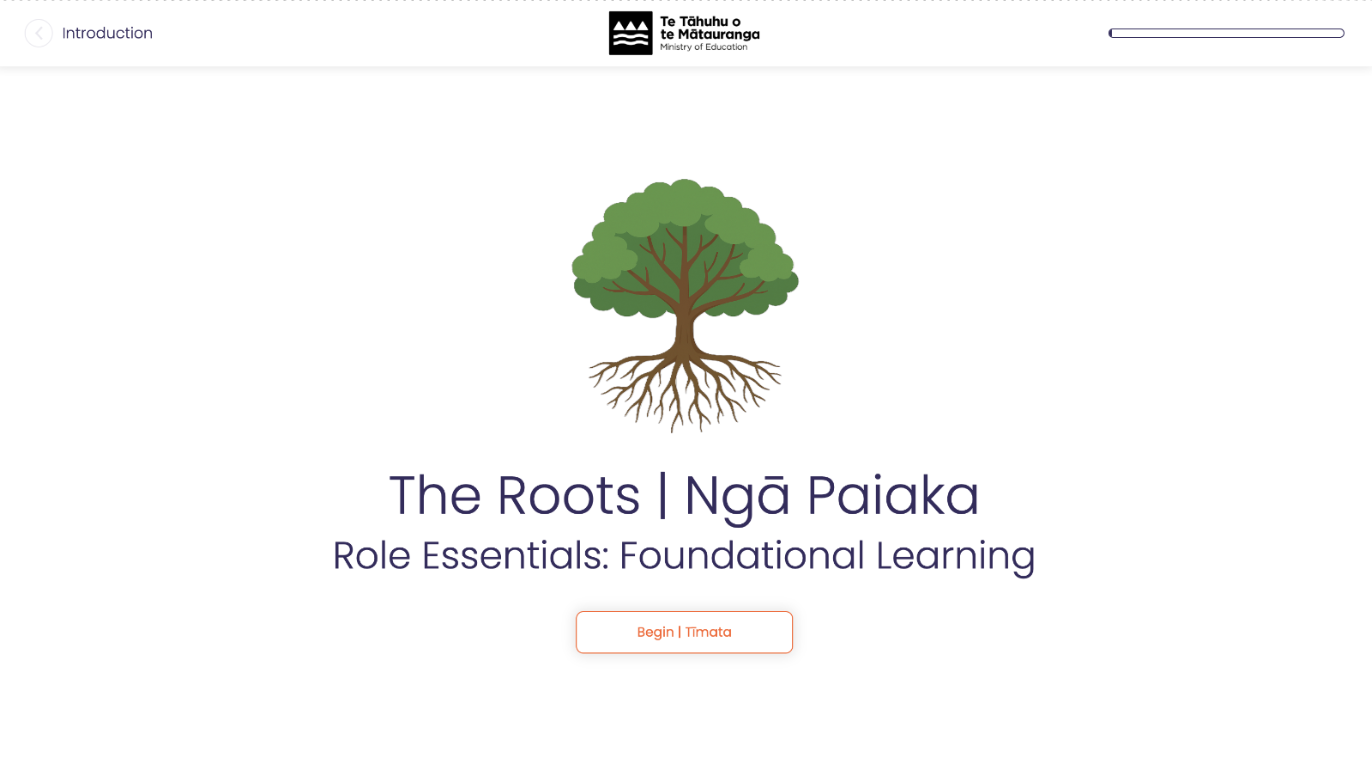
Above: A look into 'Role Essentials' the NZATD award-finalist training programme, created by Loz Wootton for the Ministry of Education.
NZATD’s annual awards celebrates and recognises outstanding individuals, teams, and organisations across New Zealand’s learning and development community. Honouring excellence across areas such as compliance, induction, leadership, and more, showcasing the very best work that drives capability and growth.
In Budget 2025, Learning Support received what its own sector has called "the funding of a generation,": a significant boost to support tamariki with learning support needs across Aotearoa. Loz was brought on in January as the Learning and Instructional Design Lead for the programme at the Ministry of Education. Her job: help make sure every Learning Support Coordinator (LSC) in the country was doing the job the same way, regardless of which region they worked in.
Building the blueprint
Loz's first task wasn't building a module. It was building a blueprint.
She developed a map of every responsibility in the LSC role description against the professional learning needed to support it, grouped into subject matter areas like leadership and coaching, bicultural learning support, and specific areas of learning need such as assistive technologies or autism/ADHD. She leaned on Bloom's Taxonomy to define three levels of capability (foundational, developing, confident) and built adult learning principles into the matrix itself, including a requirement that pre-assessments let experienced learners skip content they'd already mastered.
One subject matter area stood apart from the rest: the day-to-day mechanics of the LSC role itself. LSCs had already completed induction, which covered the what of the job. This new area needed to cover the how, and unlike the other subject matter areas, which were being built by external suppliers, this one needed deep, Ministry-specific knowledge. It became Role Essentials, and it landed on Loz's desk.
Building it in Chameleon Creator
Turning that blueprint into a real course meant Loz needed a few specific things from her tooling: the design flexibility to keep pace with a brand guide that changed mid-build, a way to build branching scenarios without relying on a developer, and a structured way to get sign-off from Ministry stakeholders at every stage, all without a graphic designer or dev team on hand.
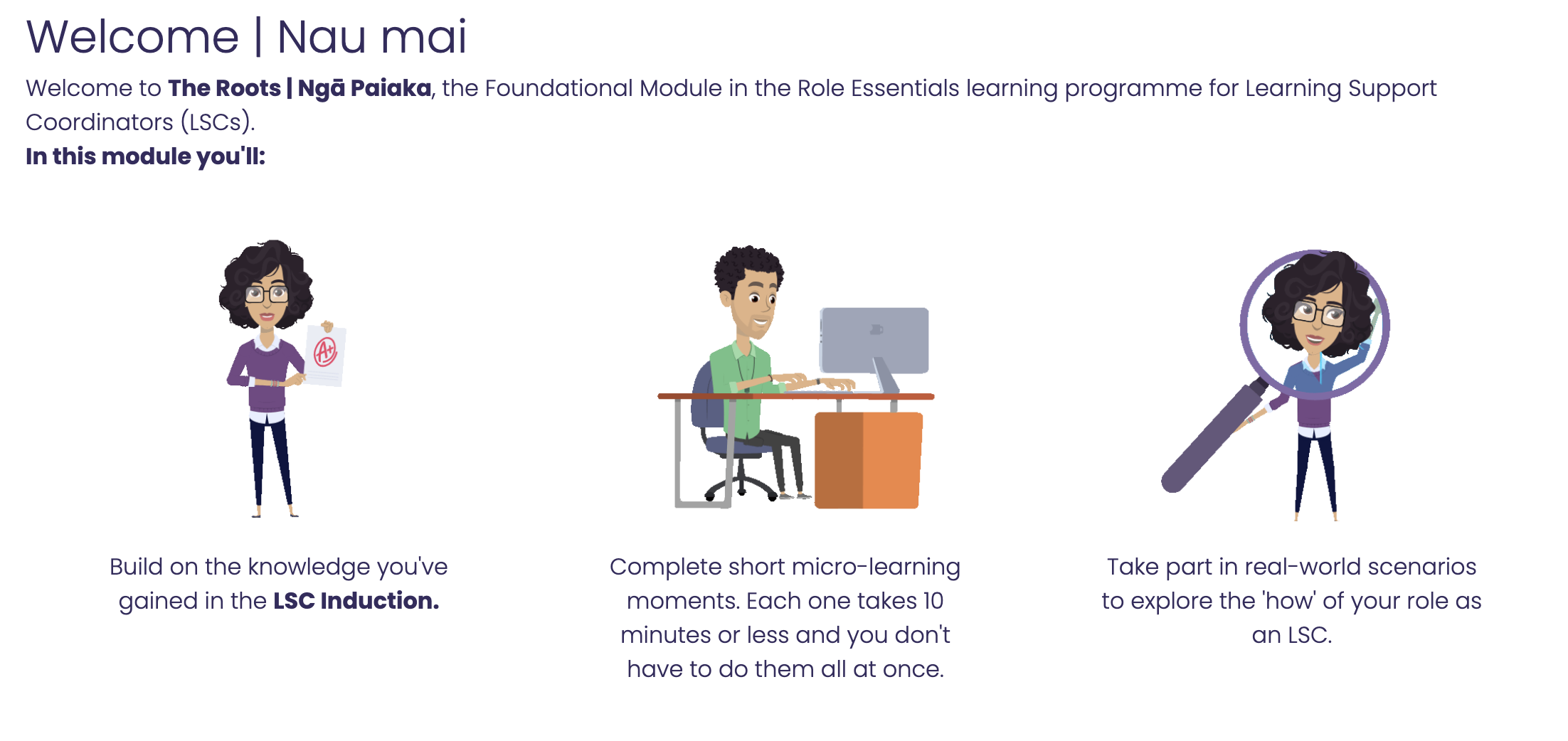
Above: Loz’s narrative-based approach to 'Role Essentials', where the learner follows two characters throughout a story.
Knowing Chameleon Creator was the right tool for the job and with the Ministry already using it, Loz could go straight from blueprint to build. As she puts it: "Luckily for this super nerd, the Ministry of Education uses Chameleon Creator!"
Her process:
First, structure. She grouped every Role Essentials responsibility into three themes: early identification and support, planning and learner supports, and building capability and helping others grow. She then mapped three courses against them, one per Bloom's level. Each course ran to roughly 40 minutes per module, about six hours of learning in total, with no pre-assessment gate since the content was role-specific rather than prior-knowledge-dependent.
Second, narrative. Loz built the whole thing around a tree, roots, trunk, fruit, as a metaphor for growth that echoes what learning support itself is about, with two characters carrying the story throughout.
Third, measurement. Confidence is hard to quantify, so Loz built her own instrument for it: a five-star confidence rating on each topic theme, asked before and after each module, with each level of learning targeting a specific star rating. Ask the same question across all three courses, and you can watch, and eventually prove, confidence building over time.
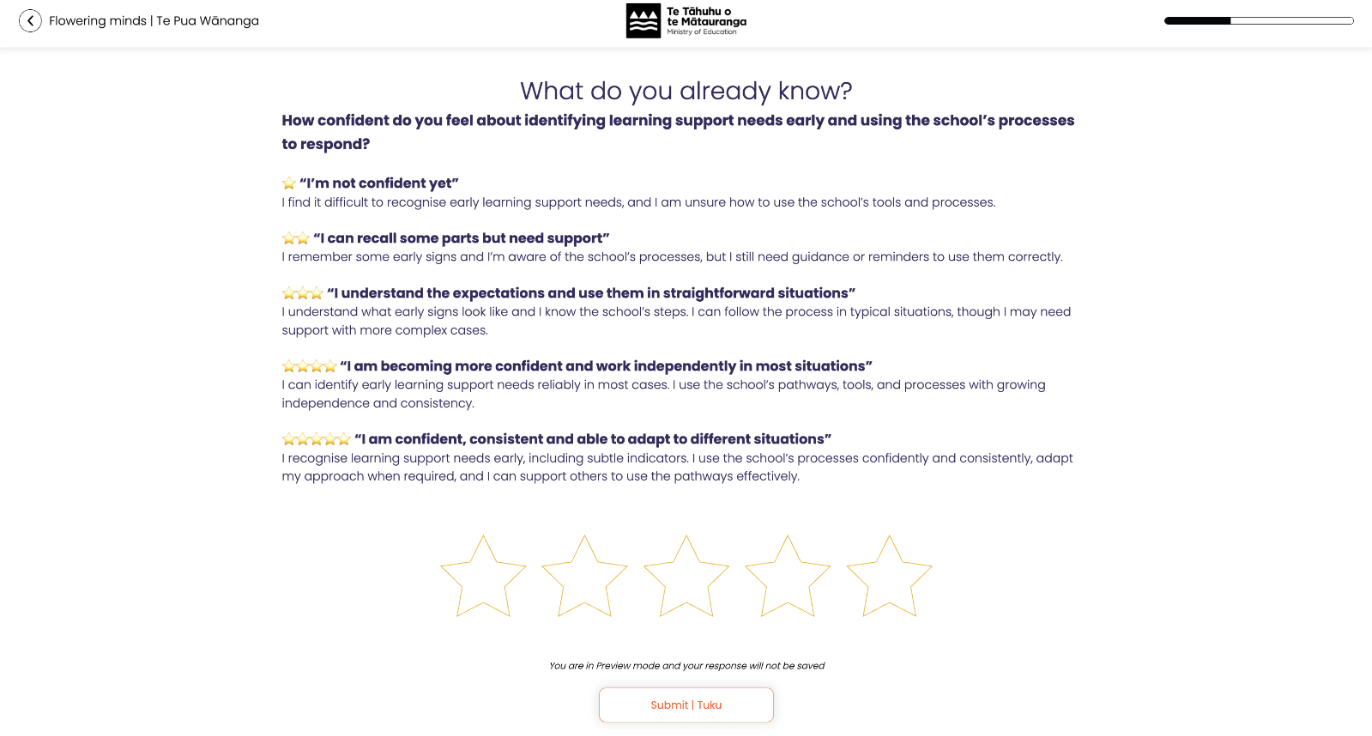
Above: To measure confidence, Loz built her own matrix using Chameleon Creator’s Rating interaction.
The whole thing went through a formal high-level design and blueprint sign-off before Loz built the drafts, then weekly feedback rounds using Chameleon Creator’s Review Tool to get it delivery-ready. Role Essentials launched in late July across the Ministry's LMS channels, with a target audience of around 1,200 LSCs and an average rating of enjoyment of 4 out of 5 stars.
Building it without a designer
Building all of this without a dedicated designer was always going to be the hard part. Loz had a brand guide that changed mid-build and sensitive content she couldn't hand off to a generic template. Her answer was Animaker, an affordable drag-and-drop animation tool she'd been looking for for ages, which became her de facto design team for videos and animation. No AI tools involved, she built it herself, learning as she went.
That's where Māia and Tama came from. The two characters, brought to life through Animaker, gave Loz a way to carry her tree narrative (roots, trunk, fruit) through the whole course as a story rather than a set of instructions, appearing as GIFs, video, and scenario participants.
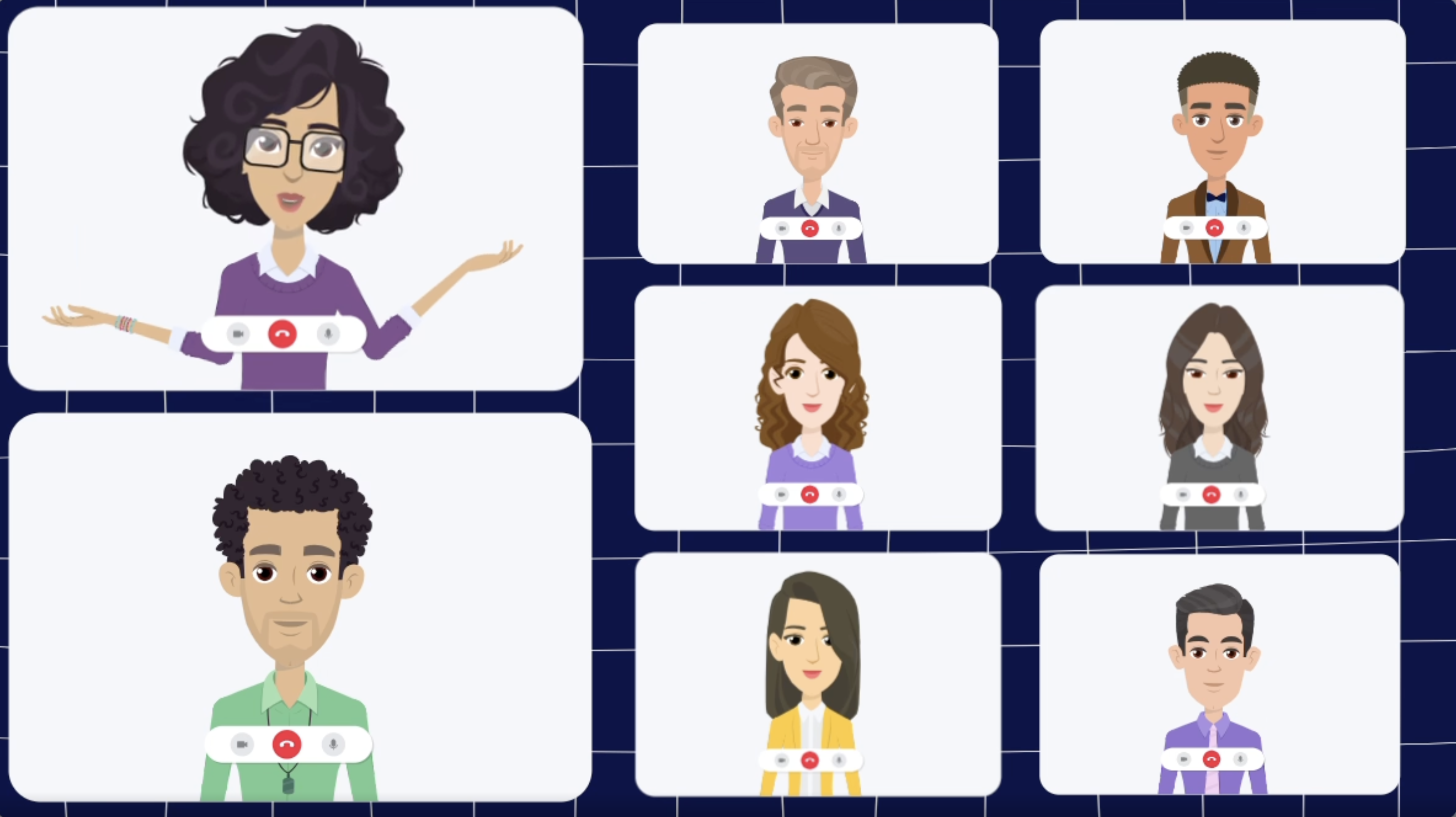
Above: The characters Loz created where Loz voices the character Māia and her partner, Conway, voices the character Tama.
Paired with Chameleon Creator's branching functionality, those characters became the backbone of course three. With the Confident level meant to build critical thinking, Loz used Māia and Tama to lead learners through nine, five-decision-point scenarios with degrading branches, real consequences, and the ability to restart or rejoin a path, all up, roughly 60 distinct decision points, still mapped back to the three original themes.
What it means to be a finalist
It's early days for hard numbers. Role Essentials only launched in late July, but already the programme averages 4 out of 5 stars for enjoyment.
We asked Loz how it felt to find out she was a finalist in all three categories she entered, and she comes back to what the recognition means for the standard of work she's building.
"I kind of feel like the NZATD Awards are, not to be super meta, like a rubric for a uni assignment. Knowing they, and other awards, exist, and what's expected of finalists, elevates my strive to achieve in every learning experience I create, with a question - 'Would this meet the requirements for awards?' - is a good one for any L&D team to sit with.
"Being recognised as someone who's consistently building learning at this awards level is a massive win for this wee contractor already."
That question, would this meet the requirements for awards, is a good one for any L&D team to sit with. Congratulations to Loz, and to fellow finalists Ministry of Education and Mitre 10, ahead of this year's NZATD Awards.
Want to see what's possible when your L&D team has the right tool for the job? [Explore Chameleon Creator →]
Share this
Top L&D Challenges of 2025 (And How to Solve Them)
Why Your eLearning Is Engaging, But Not Driving Behaviour Change